Despite the seemingly week over week benign numbers, the markets were volatile. Equity markets did close slightly down while the bond market ended the week with yields a bit lower (prices higher). Oil and natural gas ended the week higher as the Middle East war escalates. (Note we mark from Thursday to Thursday close). The US dollar and treasuries are still the safe haven of choice.
| Index | Close Mar 12h 2026 | Close Mar 19th 2026 |
| S&P500 | 6,675 | 6,619 |
| TSX60 | 32,841 | 31,855 |
| Canada 10 yr. Bond Yield | 3.53% | 3.44% |
| US 10 yr. Treasury Yield | 4.27% | 4.25% |
| USD/CAD | $1.36311 | $1.37421 |
| Brent Crude | $101.80 | $107.81 |
| Gold | $5,080 | $4,650 |
| Bitcoin | $70,309 | $70,671 |
Source: Trading Economics & Factset
There was a plethora of central bank meetings this week and the common refrain was “hold the course”. Expectations for further rate cuts are diminishing, thanks to higher oil prices and its inflationary potential. The US Federal Reserve, Bank of Canada, Bank of England, European Central Bank, Swiss National Bank, Bank of Japan, and Sweden’s Riksbank all opted for no change in rates.
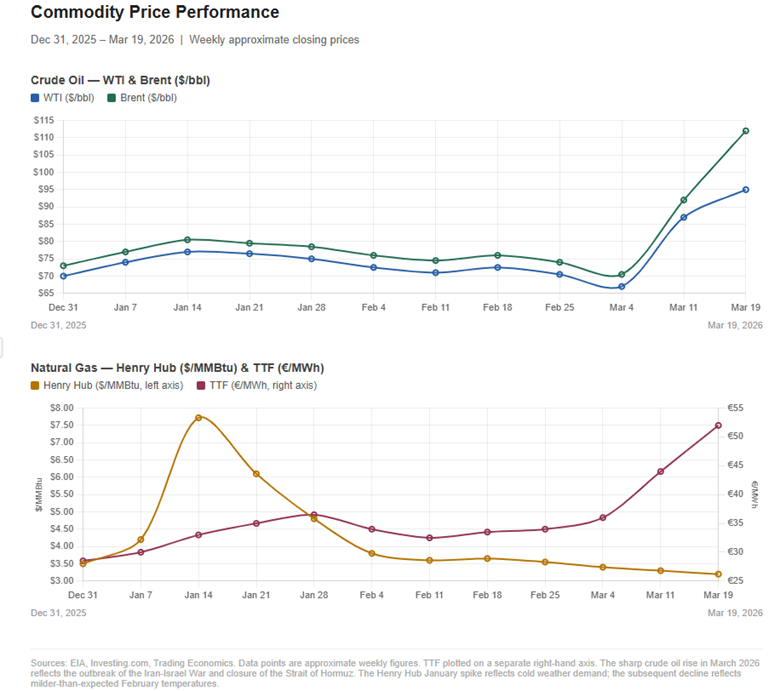
While each central bank had its own unique challenges before the outbreak of the Middle East war, the war has now put those to one side. All cited the uncertainty caused by the war, specifically the 75%+ rise in oil and 115% rise in the price of natural gas (Europe and Asia) since the start of the year. The sharp increase in energy prices could will have 2 effects – higher inflation and a slower economic growth if not contraction. The two charts below show the price movements of the main energy benchmarks – WTI (North America oil), Brent (Europe/Global oil), Henry Hub (natural gas North America), TTF (natural gas Europe). A shout out to my new assistant, Claude, for compiling the charts.
The charts also demonstrate that oil is priced as a global commodity, natural gas is priced as a continental commodity.
The US Federal Reserve had to deal not only with the prospect of higher inflation due to the war, but higher wholesale prices that pre-dated the conflict. February’s Producer Price Index (PPI) rose 0.7% month over month vs. expectations of 0.3%. PPI changes usually front run changes in consumer prices (CPI) so the higher inflation is expected to show up in the next CPI report(s).
Canada had a lot of economic date to digest this week. CPI (inflation) declined to 1.8%, below the BoC’s 2% target. There is a bit of noise in the number due to the GST holiday last year messing with the base effect. On the employment front, Canada lost 84,000 jobs in February and the unemployment rate ticked up to 6.7%. The unemployment rate is not that different than a year ago when it was 6.6%, thanks partly to a decline in the employment participation rate. On the bright side, wages were up 3.9% compared to last year. The average wage in Canada is now $37.56 per hour.
We also lost population in the past year. The 76,000 drop in residents was due to the curtailment of international student and temporary foreign worker visa issuance. That may partially explain the fall in house prices and rents over the past year. The average house price in Canada declined by 4.8% in the past year to $661,100 in February. (Averages can be misleading as the average house price in Victoria was $1.3 million). The average rent in Canada declined by 2.8% year over year to its lowest point in almost 3 years. I would argue that the rise in house prices was more a function of low interest rates. Rents can be tied more directly to the ebbs and flows of population. I will also note that without immigration, Canada’s population would be falling.
Under normal circumstances, these numbers would have most pundits calling for an interest rate cut by the Bank of Canada. Circumstances are far from normal right now, hence the cautious stance.
While we are busy integrating Claude (and Co-pilot) into some of our workflows, there is a new AI kid, Hunter Alpha, on the block. Only, nobody knows who created it. It is suspected that it is the latest iteration from Deep Seek, the disruptor developed in China. This latest AI project is optimized for “agentic” workflows, which means it can plan, reason, and execute extended tasks autonomously. It is free, which could mean you, the user, are the product.
Congratulations are due to University of Montreal professor, Gilles Brassard who won the A.M. Turing Award alongside Charles Bennet, a physicist at IBM Research. The prize was awarded for research that laid the foundations for modern quantum computing and encryption. They have been collaborating for over 30 years.
While no one is fessing up to who created Hunter Alpha, we now know who Banksy is. A Reuters report has identified the famous street artist as Robin Gunningham from Bristol. Apparently, he changed his name to David Jones (no, not the one of Monkees fame) several years ago to help avoid being outed. In any case his art has been thought provoking and a source of entertainment for many.
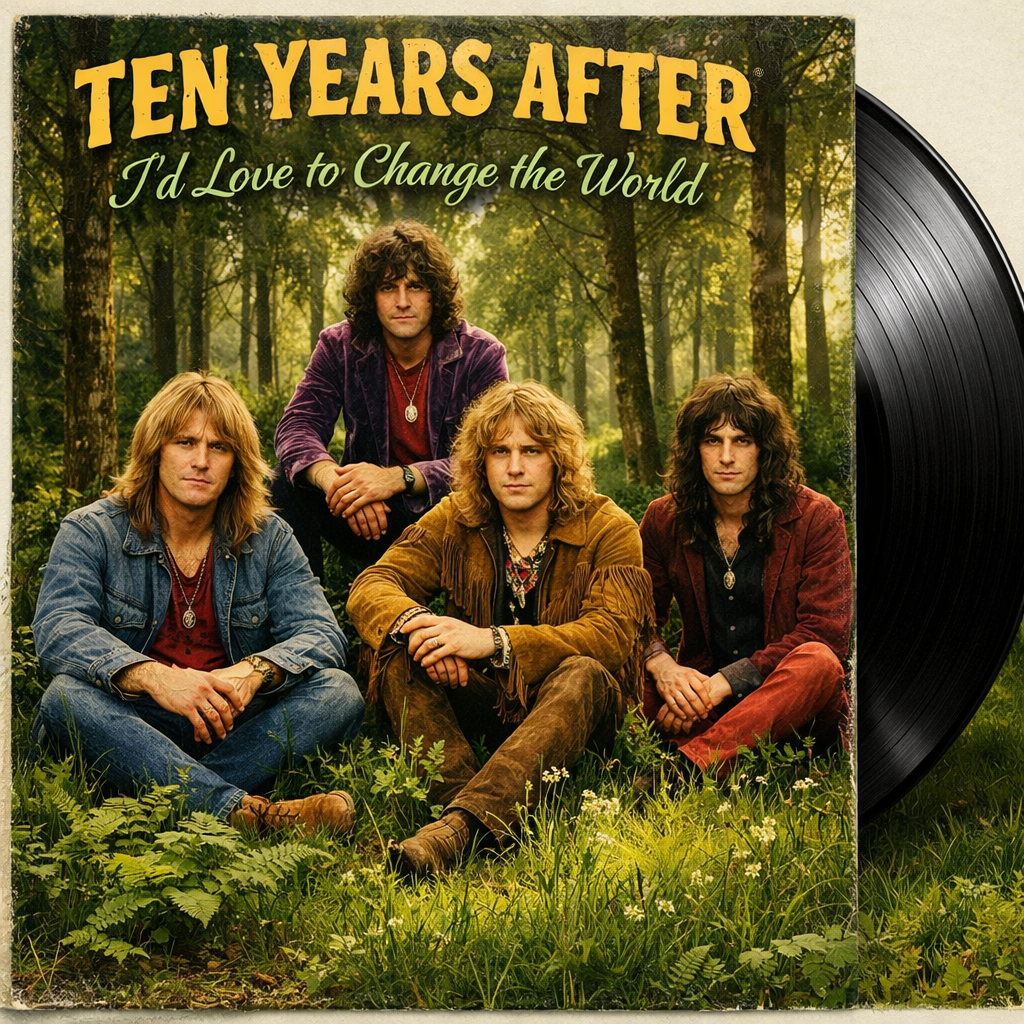
I’m sure a lot of us would like to change the world right now, but like Ten Years After, we probably don’t know what to do. I’ll leave you with this classic from the 70’s featuring some brilliant solos by the incomparable Alvin Lee… Enjoy
Russ Lazaruk, RIAC, CIWM, CIM, FCSI
Managing Director & Portfolio Manager
